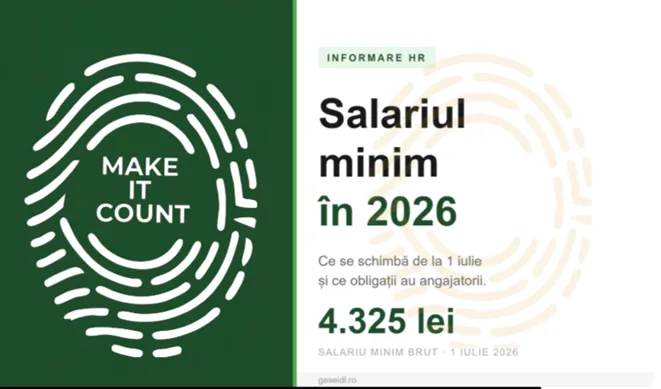
Minimum wage in 2026: what changes from July 1 and what obligations employers have
Starting from July 1, 2026, the gross minimum wage guaranteed nationally increases from 4,050 lei to 4,325 lei. The increase is important not only for salary calculations, but also for compliance with legal obligations regarding employees paid at the minimum wage level.
An essential aspect, sometimes overlooked by employers, is the rule of 24 months: an employee cannot be kept on the minimum general salary for more than 24 months. After this period, the employer must assign them a base salary that is higher than the gross minimum wage guaranteed to be paid.
What is the minimum wage in 2026
According to Government Decision no. 146/2026, published in the Official Monitor no. 196 on March 13, 2026, the gross minimum wage increases as follows:
Indicator
Until 30.06.2026 - From 01.07.2026
Gross minimum wage
1. 4,050 lei
2. 4,325 lei
Estimated net salary
1. approximately 2,574 lei
2. approximately 2,699 lei
Total cost employer
1. approximately 4,134 lei
2. approximately 4,418 lei
The increase is 275 lei gross, which is approximately 6.8%.
For the employee, the estimated net increase is approximately 125 lei per month, while for the employer the total cost increases by approximately 284 lei per month for each employee paid at the minimum level.
Attention: the net salary may vary depending on applicable tax benefits. Before communicating the final net salary to employees, it is advisable to check the applicable tax provisions.
The minimum wage in construction and other sectors
The general minimum wage should not be confused with the minimum wages established for certain sectors of activity.
For example, in construction, there is a sector-specific minimum wage, established by separate normative acts. For these domains, special rules apply, different from those regarding the general minimum wage established by government decision.
The rule of 24 months on minimum wage
The labor code stipulates that the general minimum wage can only be applied to an employee for a maximum period of 24 months.
After the expiry of this period, the employer is obliged to set a base salary that is higher than the guaranteed minimum wage to be paid.
This rule applies as follows:
- The general minimum wage can be maintained for a maximum of 24 months from the conclusion of the individual employment contract.
- For existing contracts before the introduction of the rule, the 24-month term is calculated from January 1, 2022.
- After the term has expired, the salary must be increased above the level of the minimum wage.
- The law does not establish a minimum amount for the increase in the private sector. It is important that the base salary is effectively higher than the guaranteed minimum wage.
- The rule concerns the general minimum wage, not the sector-specific minimum wages established by special normative acts.
What employers need to do
To avoid problems during an ITM inspection, employers should verify in advance the situation of employees paid at the minimum level.
Recommended steps are:
- Identifying employees who have been paid at the minimum wage level for at least 24 months.
- Establishing a base salary above the guaranteed minimum wage.
- Preparing an addendum to the individual employment contract.
- Submitting the modification in REGES Online, within the legal deadline.
- Checking the internal salary scale, especially for employees with seniority who come very close to the new minimum wage.
This verification is important for compliance, but also for maintaining a salary balance within the company.
Risks at ITM inspection
Maintaining an employee on the minimum wage after the 24-month period may attract measures imposed by labor inspectors.
In addition, employers risk fines for non-compliance with the provisions regarding the guarantee of payment of the minimum wage.
Additionally, in certain situations, the act may be treated as a continuous offense, meaning that the statute of limitations may run from the date of detection by the inspector, not from the date when the obligation was not fulfilled.
Frequently asked questions
What is the gross minimum wage in 2026? The gross minimum wage is 4,050 lei until June 30 2026 and 4,325 lei starting from July 1, 2026.
What is the net minimum wage in 2026? After July 1, 2026, the estimated net wage is approximately 2,699 lei, depending on the applicable tax benefits.
Is it mandatory to increase the salary after 2 years at minimum? Yes. After 24 months at the general minimum wage, the employer must provide a base salary higher than the guaranteed minimum wage to be paid.
How much should the salary be increased after 24 months? The law does not specify an exact amount for the private sector. The increase is negotiated, but the salary must be above the level of the general minimum wage.
Does the 24-month rule apply in construction as well? The rule applies to the general minimum wage established by government decision. For sector-specific minimum wages, distinct rules apply.
Geseidl Consulting Group
CECCAR #1 Prahova · CAFR Rating A · ANEVAR · CCF #233 · ISO 9001:2015
Learn more about us →