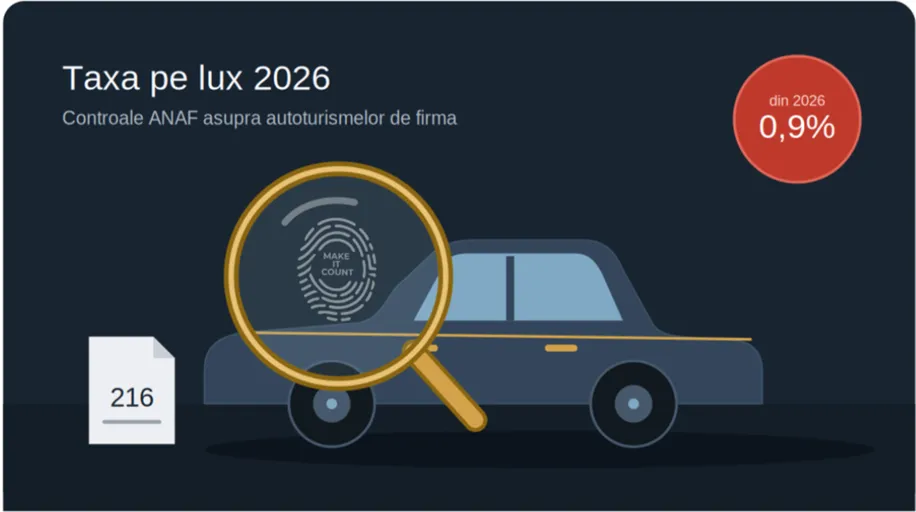
Luxury Tax 2026: Why Companies with Expensive Cars Are Questioned by ANAF
Declaring a car via form 216 is no longer, starting in 2026, a simple administrative act. For legal entities, submitting the declaration for "luxury tax" functions as a trigger for a fiscal audit: the tax authority compares the value of the asset with how the expense and related VAT have been deducted and requests proof that the car is used exclusively for business purposes. In the absence of this proof, the real stake is not the special tax of 0.9%, but the tax reclassification of the entire deduction regime.
Who Owes the Luxury Tax on Cars
The obligation falls on both individuals and legal entities that own cars registered or recorded in Romania whose individual purchase value exceeds 375,000 lei (approximately 75,000 euros).
- Calculation base: the difference between the purchase value and the threshold of 375,000 lei.
- Rate: 0.9% (starting in 2026).
- Duration: the tax is due for a period of 5 years, starting from the fiscal year in which the handover-receipt or invoicing of the car took place.
- Declaration and payment: form 216, exclusively electronic, to the competent central tax authority, by December 31 inclusive of the current fiscal year.
Example of calculation (car purchased by an LLC for 600,000 lei):
Purchase value - 600,000 lei
Non-taxable threshold - 375,000 lei
Calculation base - 225,000 lei
Rate (2026) - 0.9%
Annual special tax - 2,025 lei
Estimated total over 5 years - 10,125 lei
Control Mechanism: From Declaration to Cross-Checking
Through form 216, ANAF obtains a transparent list of companies that own high-value cars. This data is correlated with VAT records and expenses deducted in the corporate tax calculation. In practice, declaring the luxury tax signals to the tax authority a premium asset within the company's holdings and automatically raises the question: is it used exclusively for economic activity or in a mixed (and personal) manner?
The answer determines three completely different tax regimes:
- Used exclusively for business purposes - 100% VAT and 100% expense deduction, conditioned by proving exclusivity (driving log, internal usage policy, GPS/telematics, business justification).
- Mixed use - deduction limited to 50% for both VAT and related expenses (fuel, maintenance, depreciation, insurance, leasing).
- Used for personal purposes - risk of reclassification as a taxable benefit in kind at the beneficiary level (administrator/partner/employee).
Impact and Risks
The financial impact of a reclassification far exceeds the luxury tax itself:
- Unjustified deducted VAT - the difference between 100% and 50% becomes additional VAT to pay, plus interest of 0.02%/day and late payment penalties of 0.01%/day (Fiscal Procedure Code).
- Corporate tax - expenses considered non-deductible increase the taxable base; the additional tax of 16% increases with the same accessories.
- -Reclassification as a benefit in kind (personal use) - attracts 10% income tax, 25% social security contribution (CAS), and 10% health insurance contribution (CASS) at the level of the benefiting individual, with accessories for the period.
- Declarative penalties - failure to submit or late submission of form 216 is a contravention and is sanctioned with a fine, to which additional penalties for non-payment of the special tax are added.
- Risk of extended audit - a single declared premium car can turn a targeted check into a general audit on VAT and corporate tax, including previous fiscal years within the prescription period.
The most exposed segment consists of companies that have fully deducted (100%) VAT and expenses, without having prepared the justification file that proves exclusive use. In practice, the burden of proof falls on the taxpayer, not the tax authority.
Conclusion
For a legal entity, the luxury tax is not the main cost — it is the signal that triggers the verification of the deduction regime. Companies that own cars worth over 375,000 lei must decide, before any controls, whether they can substantiate with documents the exclusive use (100% deduction) or if they prudently apply the 50% limitation. Improvisation in this area transforms a tax of a few thousand lei into a fiscal reclassification of tens of thousands of lei, with accessories across multiple exercises.
The information in this article has a general character and reflects the regulatory framework applicable at the date of publication. For advice tailored to specific situations, we recommend contacting one of Geseidl's specialists.
Geseidl Consulting Group
CECCAR #1 Prahova · CAFR Rating A · ANEVAR · CCF #233 · ISO 9001:2015
Learn more about us →